





Carbon Monoxide FAQ
What is Carbon Monoxide?
Carbon Monoxide (CO) is an invisible, odorless gas that is a common by-product of incomplete combustion. Carbon monoxide is produced when fossil fuels like wood, coal, charcoal, gasoline, kerosene, natural gas, or oil burn. Because of the way that your body reacts to carbon monoxide, it is a deadly gas that must be avoided to prevent poisoning.
What causes carbon monoxide and what are some common sources of carbon monoxide?
Carbon monoxide (CO) is a by-product of incomplete combustion. Common causes of carbon monoxide production can be gas or oil appliances like a furnace, clothes dryer, range, oven, water heater, or space heaters that are not working properly. When appliances and vents work properly, and there is enough fresh air in your home to allow for complete combustion. In these typical conditions, trace amounts of CO produced by these sources are typically not dangerous.
However, there are common conditions that can cause CO levels to rise quickly:
- Appliance malfunction, i.e. the heat exchanger on your furnace cracks.
- Vent, flue, or chimney is blocked by debris or even snow.
- Fireplace, wood burning stove, charcoal grill or other source of burning material is not properly vented.
- Vehicle is left running in an attached garage and carbon monoxide seeps into the house.
- Several appliances running at the same time and competing for limited fresh air can be a cause of carbon monoxide buildup. This condition can result in incomplete combustion and produce CO, even if all appliances are in good working condition.
Where is Carbon Monoxide Found?
The following items may produce carbon monoxide:
- Anything that burns coal, gasoline, kerosene, oil, propane, or wood.
- Automobile engines.
- Charcoal grills (charcoal should never be burned indoors).
- Indoor and portable heating systems.
- Portable propane heaters.
- Stoves (indoor and camp stoves).
- Water heater that use natural gas.
Is carbon monoxide heavier than air? What is the diffusion of carbon monoxide in air?
Carbon monoxide is not heavier than air. The diffusion of carbon monoxide in air is relatively even, meaning that a source of carbon monoxide can distribute the gas evenly throughout the room and house. When installing a carbon monoxide alarm, choose a location where the alarm will stay clean, and out of the way of children or pets. See User's Manual for specific installation requirements.
What are the symptoms of carbon monoxide poisoning?
The symptoms of carbon monoxide poisoning are important to be able to recognize. If you suspect that you or someone else are experiencing sickness as the result of exposure to carbon monoxide, get to a well-ventilated area immediately and contact emergency services. Symptoms of mild carbon exposure can include: slight headache, nausea, vomiting, fatigue, flu-like symptoms. Symptoms of medium carbon monoxide exposure can include: throbbing headache, drowsiness, confusion, fast heart rate. Symptoms of high exposure to carbon monoxide can include: convulsions, unconsciousness, and heart & lung failure. Exposure can lead to brain damage and death.
Poison Control, or a local emergency number:
The National Poison Control Center (1-800-222-1222) can be called from anywhere in the United States. This national hotline number will let you talk to experts in poisoning. They will give you further instructions.
This is a free and confidential service. All local poison control centers in the U.S. use this national number. You should call if you have any questions about poisoning or poison prevention. It does NOT need to be an emergency. You can call for any reason, 24 hours a day, 7 days a week.
Why is carbon monoxide dangerous? What is the cause of carbon monoxide poisoning?
Carbon monoxide can be extremely dangerous because CO robs your blood of oxygen. When you inhale carbon monoxide, it bonds with the hemoglobin in your blood, displacing life-giving oxygen. This produces a toxic compound in your blood called "Carboxyhemoglobin" (COHb) which is the source of carbon monoxide poisoning. Over time, exposure to CO can make you feel sick or worse, victims exposed to sufficiently high levels of carbon monoxide can suffer brain damage, or even die. According to the Journal of the American Medical Association (JAMA), 1500 people die each year because of carbon monoxide poisoning, and another 10,000 become ill. Carbon monoxide is dangerous since you can't see, smell, or taste the gas. Because you can't sense it, carbon monoxide can poison you before you even know it's there.
What does "Move to Fresh Air" printed on my carbon monoxide alarm mean?
The phrase "Move to Fresh Air" that is printed on the face of newer carbon monoxide alarms is a reminder to move all family members to a well ventilated area with fresh air if the alarm sounds. Please note that this does not mean that you should unplug or move the CO alarm itself. When an alarm sounds, make sure that everyone in the building is evacuated to an area with fresh air.
What should I do when the carbon monoxide alarm sounds?
Silence the alarm. Move everyone immediately to fresh air-outdoors or by an open door or window. Do a head count to check that all persons are accounted for. Call your emergency services, fire department, or 911 and tell them your carbon monoxide alarm has triggered. Do not re-enter the premises or move away from the open door or window until the emergency services responder has arrived, the premises have been aired out, and your carbon monoxide alarm remains in its normal condition.
Why didn't the emergency responder find CO gas after an alarm?
If your carbon monoxide alarm went off, it detected a dangerous level of CO gas. Here are some reasons why a responder may not find CO during an investigation:
- Carbon monoxide gas dissipated in fresh air. If windows and doors open before a responder arrived, the same concentration of CO gas may no longer be present. Be safe first and vent dangerous carbon monoxide gas to the outside. The responder can try to recreate the conditions.
- The alarm may have been caused by an on-again, off-again problem. CO alarms measure gas exposure over time, so the exact conditions that cause an alarm may be difficult to duplicate in an investigation.
Will carbon monoxide alarms detect explosive gas leaks?
No, a single function carbon monoxide alarm reacts to carbon monoxide only. To detect explosive gas, you need an explosive gas detector. Different kinds of explosive gas can be detected and it is recommended that any home that utilizes natural or propane gas have at least one explosive gas leak detector.
What is the typical carbon monoxide alarm life? How long will a CO alarm last?
A First Alert carbon monoxide alarm life span is warranted for 5 years. After 5 years any alarm should be replaced with a new CO Alarm. Alarms may have an actual life span that is shorter due to environmental conditions and may need to be replaced sooner. Batteries should be replaced as needed for those alarms requiring them.
Where should I install carbon monoxide alarms? What is proper carbon monoxide alarm placement?
It is very important to install carbon monoxide alarms near or in each separate sleeping area. Many states now require that a carbon monoxide alarm is placed in each bedroom. For added protection, placement of an additional carbon monoxide alarm at least 15-20 feet away from the furnace or fuel burning heat sources is recommended. Also, install carbon monoxide alarms at least 10 feet from sources of humidity like bathrooms and showers. In two story houses, install one carbon monoxide alarm on each level of the home. If you have a basement, carbon monoxide alarm placement is recommended at the top of the basement stairs.
Is there anywhere I shouldn't install carbon monoxide alarms?
Do not install carbon monoxide alarms in garages, kitchens, furnace rooms, or in any extremely dusty, dirty, humid, or greasy areas. Do not install alarms in direct sunlight, or areas subjected to temperature extremes. These include unconditioned crawl spaces, unfinished attics, un-insulated or poorly insulated ceilings, and porches. Carbon monoxide alarms should not be installed in outlets covered by curtains or other obstructions. Do not install in turbulent air-near ceiling fans, heat vents, air conditioners, fresh air returns, or open windows. Blowing air may prevent carbon monoxide from reaching the CO sensors.
How many carbon monoxide alarms should I have in my home?
So how many carbon monoxide alarms should you have in your home? The National Fire Protection Association (NFPA) recommends that you should have a carbon monoxide alarm centrally located outside of each separate sleeping area in the immediate vicinity of the bedroom. For added protection, you should have additional carbon monoxide alarms in each separate bedroom and on every level of your house, including the basement. Some states now require that you have a carbon monoxide alarm in each bedroom of the house. If you install only one carbon monoxide alarm in your home, place it near or in your bedroom.
Why does the red light flash on my carbon monoxide alarm? Do I have CO?
On First Alert carbon monoxide alarms, the red light flashes to show the CO alarm is properly receiving battery power. If you do not see the red light flashing, change the batteries in the alarm immediately.
Can I unplug the carbon monoxide alarm to silence or reset it, or do I need to leave it plugged in?
Do not unplug your alarm! A First Alert plug-in carbon monoxide alarm will only reset when it is receiving electricity. Press and hold the Test/Silence button for 5 seconds to quiet a plug-in alarm while ventilating. You may have to do this numerous times to give the alarm time to reset.
What is the proper way to do a carbon monoxide alarm test?
The following procedure is the proper way to do a carbon monoxide alarm test - Press and hold the Test Button on the front of the alarm until the alarm sounds. Be sure you hold the button down long enough; it can take up to 20 seconds for the alarm to respond to the test.
Can I test my carbon monoxide alarm in any other way besides pressing the test button?
Pressing the test/silence button is the only proper way to test the CO alarm. NEVER use vehicle exhaust or some other source of combustion fumes. Exhaust causes permanent damage and voids your warranty.
Can I remove the battery from the carbon monoxide alarm to silence or reset it?
Do not remove the battery from your carbon monoxide alarm to silence or reset it. The carbon monoxide alarm is designed to reset automatically. Use the Test/Silence Button to quiet the alarm while the alarm is resetting. Leave the battery in your carbon monoxide alarm.
Is there an audible and visual warning for carbon monoxide presence in the First Alert carbon monoxide alarm?
In the First Alert family of carbon monoxide alarms, an 85-decibel alarm will sound when carbon monoxide reaches the alarm level. Some of our carbon monoxide alarms have lights to indicate if the alarm is in early warning or full alarm. Check your user's manual to determine how your carbon monoxide alarm works.
What is the expected carbon monoxide alarm battery life?
Actual carbon monoxide alarm battery life depends on the specific carbon monoxide alarm and the environment in which it is installed. Batteries specified in the user's manual are the only acceptable replacement batteries. Regardless of the manufacturer's suggested carbon monoxide alarm battery life, you MUST replace the battery immediately if the unit starts "chirping" to signal the end of its battery life. It is recommended that you change the batteries in your alarms when you change your clocks for daylight saving time.
Should I leave my carbon monoxide (CO) alarm plugged in all year?
Leave your carbon monoxide alarm plugged in all year. Carbon monoxide gas problems can happen at any time. Remember, your furnace or space heaters aren't the only source of carbon monoxide. Gas ranges, water heaters, dryers, charcoal grills, or vehicles left running in an attached garage can all cause carbon monoxide gas problems.
How do I get my carbon monoxide alarm to stop chirping?
If your carbon monoxide alarm keeps chirping, the battery may be low or weak. On First Alert carbon monoxide detectors, check to see if the battery light is yellow or green. If the alarm is chirping and the light is yellow, it means the battery is low. The way to get a carbon monoxide alarm to stop chirping is to replace the battery.
Why is the green power light flashing on my First Alert plug-in carbon monoxide alarm?
With all First Alert plug-in carbon monoxide alarms, any time there is a power outage, brownout, surge or other problem with the power, the alarm goes through a power up cycle. The flashing on your plug-in carbon monoxide alarm should stop after 5 minutes, then the light will stay a steady green.
Can you reset a plug-in carbon monoxide alarm with the test/silence button?
No, the test/silence button only tests or silences the carbon monoxide alarm. To reset the alarm, the unit needs fresh air and time to burn the contamination off the sensor. Push and hold the silence button for 5 seconds to silence the alarm while contamination is being burned off the sensor. You may need to do this a number of times to give the carbon monoxide alarm enough time to reset.
Where should I install carbon monoxide alarms and in particular, how high off the floor?
Carbon monoxide weighs about the same as air and distributes evenly throughout the room/house. When you decide where to install a carbon monoxide alarm, choose a location where the carbon monoxide alarm will stay clean and out of the way of children or pets. It is important to refer to your user's manual for specific installation requirements as to where to install your carbon monoxide alarm.
What are unsafe levels of carbon monoxide?
Determination of unsafe levels of carbon monoxide is different for each person. Since carbon monoxide is a poison, it affects everyone at different levels. Age, size, and health are other factors that can determine the effect carbon monoxide has on them. You should contact your own physician for advice regarding the issues of safe carbon monoxide levels. Everyone is at risk at some level from carbon monoxide poisoning, but some people are more vulnerable than others. Unborn babies, infants, children, seniors, and people with heart or lung problems may be at higher risk from carbon monoxide poisoning for a variety of reasons. Be sure to install carbon monoxide detectors for protection against unsafe levels of carbon monoxide.
Is it a false alarm when my carbon monoxide alarm sounds and there doesn't seem to be a problem?
A carbon monoxide alarm false alarm should not occur if your alarm is in working order. Remember, carbon monoxide is an odorless, colorless gas. If your carbon monoxide alarm went off, it detected potentially harmful amounts of carbon monoxide. After the professionals have evaluated the situation, make sure no one has any symptoms of carbon monoxide poisoning.
Here are a few situations that may cause a carbon monoxide alarm "false alarm:"
- The carbon monoxide alarm needs to be relocated. Carbon monoxide alarms should be located 15-20 feet away from all fossil fuel burning sources like furnaces and stoves. Alarms should be located 10 feet away from sources of humidity like showers.
- Fossil fuel burning appliances may not be burning fuel completely. Check pilot lights/flames for blue color. Appearance of yellow or orange flames indicates incomplete combustion-a source of carbon monoxide.
The Following is an Assortment of Carbon Monoxide Alarms we Readily Offer:
Basic Battery Operated Carbon Monoxide Alarm
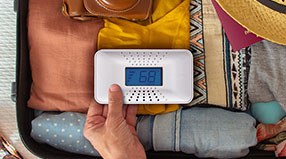
Battery operated carbon monoxide alarm with mute button to silence any nuisance alarms. Single button also tests alarm functions. Carbon monoxide alarm utilizes electrochemical sensor for increased accuracy. Has easy, front access to the battery. 5-year limited warranty. Carbon Monoxide alarm meets UL standards.
Basic Plug-In Carbon Monoxide Alarm
Plug-in carbon monoxide alarm easily plugs into any standard outlet with no additional mounting necessary. Mute button silences any nuisance alarms. Single button also tests alarm functions. Carbon Monoxide alarm utilizes electrochemical sensor for increased accuracy. 7-year limited warranty. Carbon monoxide alarm meets UL standards.
Combination Explosive Gas and Carbon Monoxide Alarm with Backlit Digital Display
Plug-in combination explosive gas and carbon monoxide alarm with battery backup and backlit digital display easily plugs into any standard outlet with no additional mounting necessary; line cord offers multiple placement options. Battery backup ensures alarm works even during power outages. Digital display illuminates hazard level when in alarm or when any button is pressed. Remote mute silences nuisance alarms by pressing any button on a standard household remote control (remote not included). Single button also tests alarm functions. Explosive gas and carbon monoxide alarm utilizes electrochemical carbon monoxide sensor for increased accuracy. 5-year limited warranty. Combination explosive gas and carbon monoxide meets UL standards.
Combination Smoke and Carbon Monoxide Alarm
The First Alert Hardwired Combination Smoke and Carbon Monoxide Alarm uses an electrochemical CO sensing technology and Ionization sensor for smoke detection. It includes a 9-volt battery for continued function in the event of a power outage, and it features a test/silence button, tamper-resistant locking brackets, and a universal mounting bracket. This CO smoke detector can be connected to other compatible BRK and First Alert hardwired smoke and carbon monoxide detectors. Its latching alarm indicator automatically identifies which unit initiated the alarm - even after the conditions that set off the alarm have subsided.
Plug-In Carbon Monoxide Alarm with Battery Backup
Plug-in carbon monoxide alarm with battery backup easily plugs into any standard outlet with no additional mounting necessary. Battery backup ensures alarm works even during power outages. Mute button silences any nuisance alarms. Single button also tests alarm functions. Carbon monoxide alarm utilizes electrochemical sensor for increased accuracy. 7-year limited warranty. CO alarm meets UL standards.
Plug-In Carbon Monoxide Alarm with Battery Backup & Backlit Digital Display
First Alert's plug-in carbon monoxide alarm with battery backup offers several unique installation options. This alarm easily plugs into any standard outlet with no additional mounting necessary or it can also be mounted on any wall using the convenient power line cord(approx. 6 feet long). Battery backup ensures alarm works even during power outages. Digital display illuminates hazard level when in alarm or when any button is pressed. Remote mute silences nuisance alarms by pressing any button on a standard household remote control (remote not included). Single button also tests alarm functions. Carbon monoxide detector utilizes electrochemical sensor for increased accuracy. 7-year limited warranty. Carbon monoxide alarm meets UL standards.
10 Year Combo Photoelectric Smoke & Carbon Monoxide Alarm with Voice & Location Feature
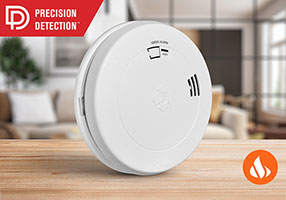
The First Alert PRC710V Combination Photoelectric Smoke and Carbon Monoxide Alarm with 10-Year Battery and Voice and Location helps protect your home from two potentially deadly threats by providing up to a decade of uninterrupted monitoring. Equipped with dual sensors, this low-profile alarm detects smoke from slow-burning, smoldering fires. Half as thick as a standard alarm, this detector has a slim, contemporary design that mounts unobtrusively on a wall or ceiling. A built-in 10-year lithium-ion battery provides continuous power, with no need to ever worry about changing the battery during the lifetime of the alarm.
Battery Operated Carbon Monoxide Alarm with Backlit Digital Display
Battery operated carbon monoxide alarm with backlit digital display illuminates with hazard level when in alarm or when any button is pressed. Remote mute silences nuisance alarms by pressing any button on a standard household remote control (remote not included). Single button also tests alarm functions. Carbon monoxide alarm utilizes electrochemical sensor for increased accuracy. Has easy, front access to the battery. 7-year limited warranty. Carbon monoxide detector meets UL standards.
Carbon Monoxide Detectors and CO Alarms