






10 Year Battery Alarms
First Alert 10-year battery alarms provide long-lasting detection without routine battery replacements. These alarms use a sealed power source designed to operate for the life of the device, helping eliminate the inconvenience of replacing batteries and reducing late-night low-battery chirps during normal service life.
Choose from First Alert 10-year battery smoke alarms, carbon monoxide detectors and combination smoke and CO alarms. Smoke alarms provide early warning of a potential fire, while carbon monoxide alarms monitor for an invisible and odorless gas. Combination models place both types of detection into one convenient device.
Available features vary by model and may include Precision Detection advanced sensing technology, voice and location alerts, slim-profile designs, digital displays, safety path lights, smart connectivity, test and silence controls, and end-of-life warnings. Compare each alarm’s detection type and features to select the protection that fits your home.
Shop First Alert 10-year battery smoke and carbon monoxide alarms for convenient, low-maintenance protection. These battery-powered alarms do not require a hardwired electrical connection, making them suitable for many existing homes and locations without alarm wiring.
Why Choose a First Alert 10-Year Battery Alarm?
A sealed 10-year battery helps simplify alarm maintenance by eliminating routine battery replacements. Once the alarm is activated and installed, its built-in power source is designed to last for the alarm’s rated service life. This can be particularly convenient for bedrooms, hallways, rental properties and hard-to-reach installation locations.
Because the battery is sealed inside the unit, it cannot be removed or replaced. This tamper-resistant design helps prevent an alarm from being left without power because someone removed its battery. When the alarm reaches the end of its service life, the entire device is replaced.
Smoke, Carbon Monoxide or Combination Detection?
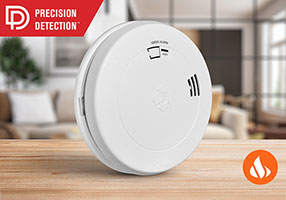
A 10-year battery smoke alarm monitors for smoke but does not necessarily detect carbon monoxide. Depending on the model, available smoke-alarm features may include Precision Detection technology, voice alerts, a safety path light or a slim-profile design.
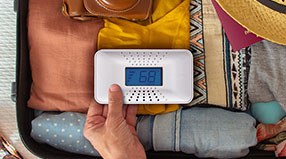
A 10-year carbon monoxide alarm monitors specifically for elevated CO levels. Select models may include a digital display showing CO concentrations, peak readings or room temperature. A standalone CO detector does not provide smoke or fire detection.
For 2-in-1 protection, choose a 10-year combination smoke and carbon monoxide alarm. These models contain separate sensing systems for smoke and CO, allowing one device to provide warnings for both dangers.
Choosing the Right 10-Year Alarm
Begin by identifying the type of detection needed in each location. Do not assume that every alarm with a 10-year battery detects both smoke and carbon monoxide. Confirm whether the product is labeled as a smoke alarm, CO alarm or combination smoke and CO alarm.
Next, compare the available alert and convenience features. Voice alerts may identify the type of danger, while digital displays can provide additional carbon monoxide information. Precision Detection technology is designed to help reduce cooking-related nuisance alarms while providing early warning of a home fire emergency. Features vary by model.
Installing and Activating a 10-Year Battery Alarm
First Alert 10-year battery alarms do not require routine household electrical wiring, but they must still be installed in an appropriate location. Smoke and combination alarms are generally mounted to a wall or ceiling using the included bracket. Certain standalone CO models may be approved for tabletop or shelf placement.
Follow the activation instructions provided with the alarm. Some sealed-battery models activate when attached to their mounting bracket, while others use a switch or activation mechanism. Test the alarm after installation to confirm that it has been activated properly.
Maintaining a Sealed-Battery Alarm
A sealed 10-year battery reduces battery maintenance, but it does not make the alarm maintenance-free. Test the alarm regularly, keep it clean and follow all instructions in the product manual. Never paint over an alarm or cover its sensing openings.
Pay attention to chirps, indicator lights, voice messages and end-of-life warnings. If a sealed alarm produces a low-power or malfunction warning, consult its manual rather than attempting to open the alarm or replace its battery.
Replacing a 10-Year Battery Alarm
The entire alarm must be replaced when its sealed battery or sensors reach the end of their rated life. Check the manufacture date, replace-by date and end-of-life information printed on the back of the alarm.
"10-year battery" describes the expected power source and service-life design; it is not a reason to ignore a malfunction or end-of-life warning. Replace an alarm sooner if directed by the manufacturer, if it becomes damaged or if it fails a test.